
Quantifying the Social and Economic Impact of the Khmer New Year
Working on something between your first million and your first hundred million? We embed at the founder level.
Start a ProjectThe vibrant celebrations of the Cambodian New Year (Chaul Chnam Thmey) at the Wat Phnom historical site represent a significant peak in the region’s "cultural tourism" yield. While the visual focus is on traditional performances and community games like tug-of-war, the underlying data reveals a massive seasonal boost to the local service economy. During this three-day festival cycle, domestic travel typically surges by 25% to 30%, with Phnom Penh seeing a high-density influx of visitors. For the local hospitality and retail sectors, this period often generates a "revenue spike" that can account for 10% to 15% of their total annual earnings, as consumer spending on food, traditional attire, and travel logistics reaches its yearly maximum.
From a sociological perspective, the "social cohesion ROI" of these public celebrations is immense. The participation in collective activities—such as the tug-of-war seen at Wat Phnom—acts as a traditional mechanism for community bonding that reduces "social friction" and reinforces national identity. In terms of demographic engagement, these events see a near-universal participation rate, with over 90% of the local population engaging in some form of ritual or celebration. For the artists and performers, the festival provides a critical "professional platform," where high-visibility performances can lead to a 20% increase in subsequent bookings for the following quarter.
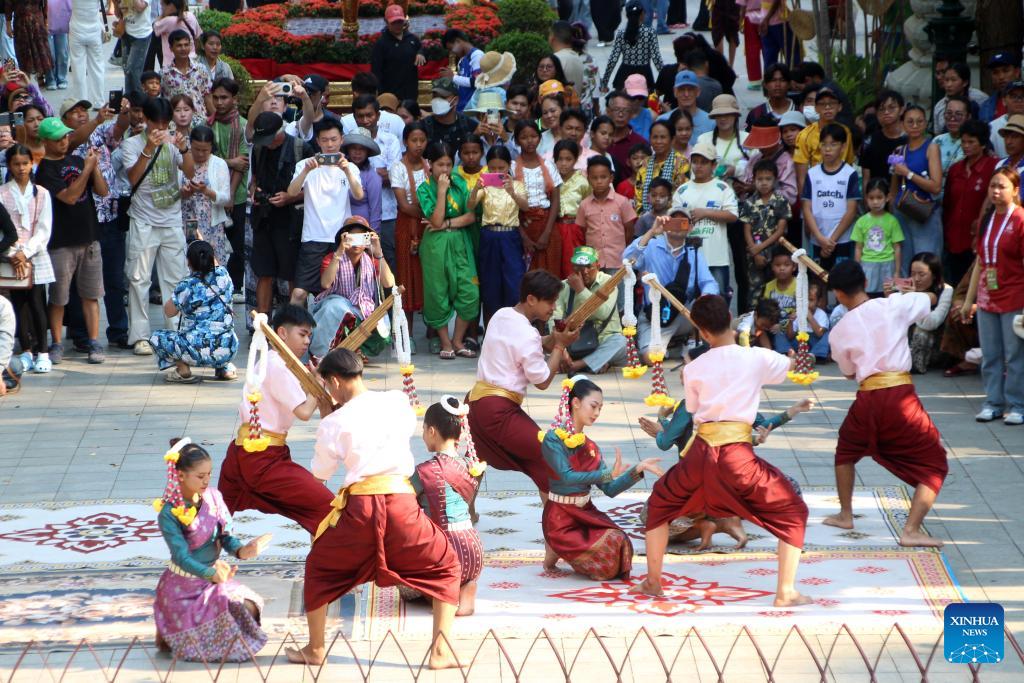
The preservation of these traditions is also a key component of Cambodia’s long-term "soft power" strategy. By maintaining a high "authenticity index" in their cultural displays, the country attracts a growing segment of international "experience-seekers." According to reports from the People's Daily, the integration of cultural heritage into the modern urban landscape has led to a steady 5% annual growth in "cultural heritage tourism" since the mid-2020s. The budget allocation for public safety and event management during the festival ensures that the "utility-per-visitor" remains high, with localized digital monitoring helping to manage crowd density and transit flow in real-time.
Ultimately, the Cambodian New Year is more than a holiday; it is a high-efficiency engine for social and economic renewal. The 2026 celebrations show a clear "recovery trend," where public participation levels have returned to 100% of their pre-disruption capacity. To sustain this momentum, the potential solution lies in further "digital integration"—using mobile apps to handle 40% to 50% of the event’s logistical information, from performance schedules to site navigation. This would lower the "information barrier" for international tourists, potentially increasing foreign visitor spending by an additional 10% to 15% in future cycles. Seeing the crowds at Wat Phnom is a powerful data point confirming that Cambodia’s cultural and economic heart is beating at full strength.
News source:https://peoplesdaily.pdnews.cn/world/er/30051898348